


.webp)

Anyone in presales knows the drill. It's 4 PM on a Friday and an AE pings you to "just knock out a quick security section." Your weekend is gone. A 400-row spreadsheet is now your problem. And somehow your technical judgment, rendered in bullet points over the next 48 hours, decides whether a real deal moves forward or quietly dies.
Most of what's out there on the RFX process isn't written for us. It's written for procurement teams, the folks actually sending these documents out. Fine for them, less useful when you're the one staring down a 90-page questionnaire with half the stakeholders unnamed and a turnaround that assumes you don't have a pipeline to work.
So this guide goes the other way. It's about what an RFI, RFQ, or RFP actually means when you're on the receiving end, and how to respond in a way that wins more deals without putting your team through hell.
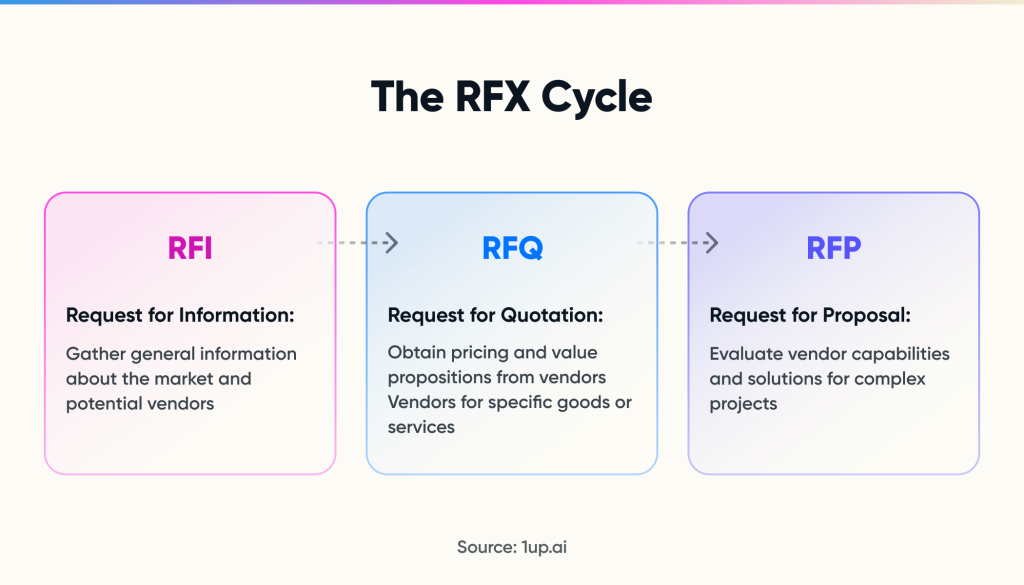
The Three Requests You'll See, Ranked by How Much Pain They Cause
Quick version before we get into it:
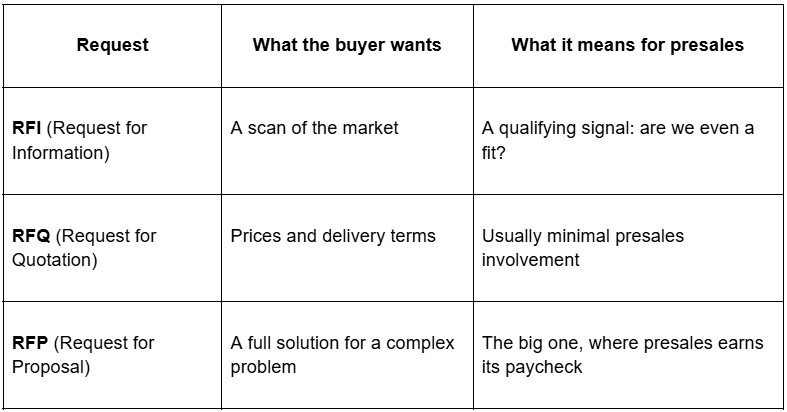
In practice, most presales teams burn the majority of their RFX time on RFPs, a decent chunk on RFIs, and almost nothing on RFQs. But the distinction still matters, because it tells you two things that shape everything else: how much effort this deserves, and where the buyer actually is in their decision process.
Stage 1: Responding to an RFI Without Over-Committing
RFIs are exploratory. The buyer is still figuring out what's possible, who might be worth a real conversation, and whether they even need to run a full process. Sometimes they don't have budget yet. Sometimes they don't have exec buy-in. Sometimes they're just curious.
Here's the trap: the questions in an RFI often look technical, which makes presales teams treat them like a real evaluation. Resist that.
What a good RFI response actually looks like:
- Short, confident answers. You're demonstrating capability, not writing a whitepaper.
- Pointers to where the real detail lives (datasheets, demo library, customer stories)
- No custom architecture diagrams unless the deal size genuinely justifies it
- No pricing. If the buyer is asking for price in an RFI, they're either confused, or they're fishing for a number to put in a spreadsheet.
Before you spend real time on one, ask yourself a few things:
Is this targeted or shotgun? Five specific questions about your core differentiators? Probably serious. The same 60-question doc blasted to 20 vendors? You're market research. The ROI on a heavy response is basically zero.
Who's actually asking? A named procurement contact at a target account is worth the effort. An anonymous alias from a company you've never heard of, usually isn't.
Is there a timeline? No timeline, no decision. RFIs floating in the ether with no stated deadline tend to stay that way.
The real skill at this stage isn't writing, it's qualifying. The presales leader's job is to keep the team from dumping 40 hours into something that was never going to close.
Stage 2: The RFQ (and Why You Probably Won't See Many)
RFQs are transactional. At this point the buyer already knows what they want. They're just comparing prices, SKUs, and delivery terms across a few vendors.
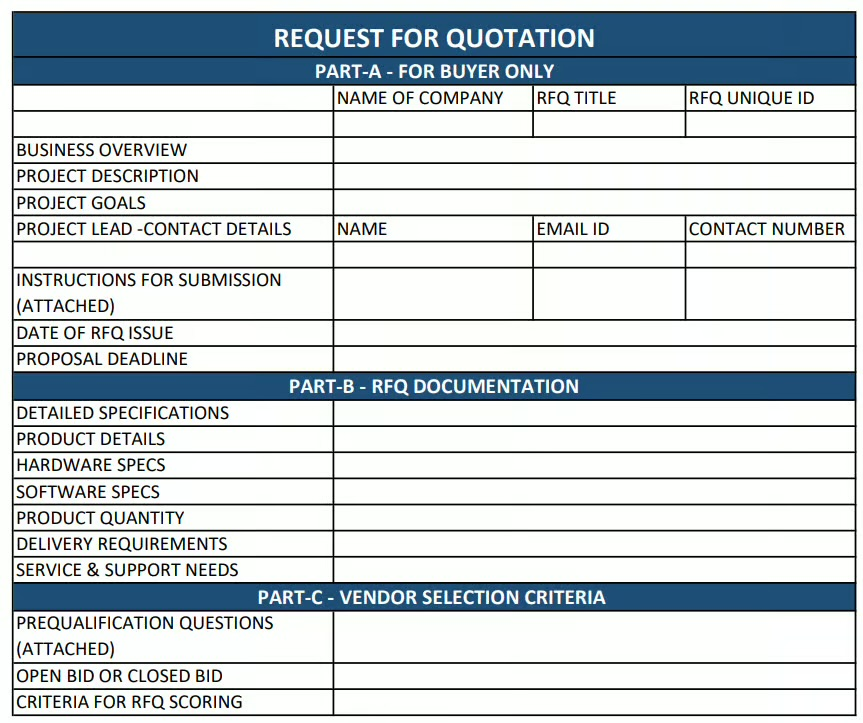
In hardware, logistics, and commoditized services, RFQs are everywhere. In SaaS and complex B2B software? Not really. When they do show up, it's usually from a mature procurement org that's already done their internal evaluation and just needs a formal quote to move the paperwork forward.
If you do get pulled in, the job is narrow:
- Validate the technical scope so the price lands accurate
- Flag anything that could blow up later (integrations, data volumes, seat counts)
- Stay out of your AE and deal desk's way
RFQs are a signal that the deal is late-stage. Don't re-open the evaluation. Don't suggest a different tier unless something is genuinely broken. Your value here is being precise, not being persuasive.
Stage 3: The RFP, Where Presales Actually Wins Deals
The RFP is the one that matters. It's also the one that, if you don't have a system, will swallow your team's calendar whole.
An RFP is how a buyer formally evaluates full solutions to something complicated. It'll usually include company background, project goals, technical requirements, submission rules, and evaluation criteria. And the thing that separates a winner from a loser is almost never the feature set. It's whether you demonstrate that you actually understand what the buyer is trying to do, and that you can credibly deliver the outcome they care about.
The four things buyers actually score on
Strip away the industry-specific stuff and most RFP scoring rubrics come down to some version of these:
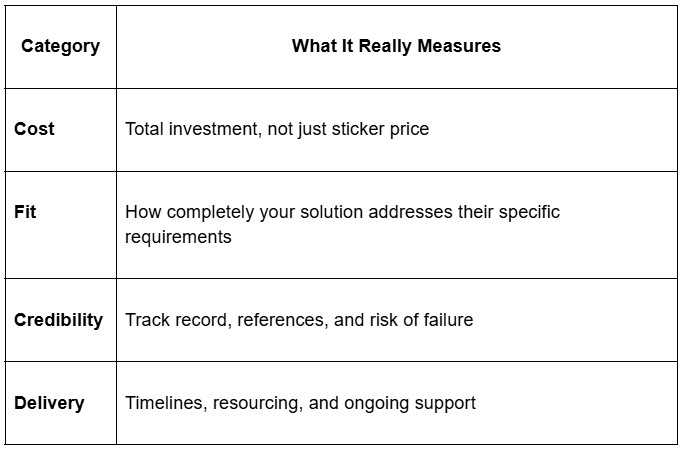
Presales owns the middle two. Cost gets shaped by your AE and deal desk. Delivery is mostly customer success or implementation. But fit and credibility live in your answers, your diagrams, and your proof points. That's where you win or lose.
What separates a strong RFP response from a weak one
Weak responses read like product docs. Strong ones read like a consultant's assessment. They call the buyer's goals out by name. They link specific capabilities to specific outcomes. They use the buyer's vocabulary, not yours. The difference is obvious when you read them side by side, even if it's hard to articulate why.
A few tactical things that consistently work:
- Answer the question first, context second. Nobody wants to wade through a paragraph of marketing copy before they find out if you support SSO. Buyers are reading these in batches and they reward directness.
- Use the buyer's language. If they call it a "broker-dealer workflow," don't swap in "trading pipeline." Matching their terminology signals fluency and pattern-matches you as someone who's done this before.
- Claims need proof. "Yes, we support SSO" is fine. "Yes, we support SAML 2.0 and OIDC, and here's a production customer using it" is a lot better.
- Be honest about gaps. A partial fit explained clearly beats an overpromise that gets exposed in the reference call. Procurement people talk to each other. Vendors who oversell in RFPs get remembered.

The Response Workflow That Actually Scales
If you're a lone SE handling one RFP a month, spreadsheets and caffeine can get you there. If you're a team dealing with dozens, you need a real system. This is roughly the shape of what works under volume.
1. Qualify before you commit
Before anyone writes a single answer, the AE and the presales lead should be able to answer three things:
- Is this an account we actually want?
- Do we have a real shot, or are we column fodder for someone else?
- Is the level of effort actually justified by the deal size and the probability?
If any of those is a no, the right call is often to not respond at all, or to submit something minimal. The presales leaders who normalize no-bid decisions tend to run healthier teams. The ones who say yes to everything burn out their best people.
2. Build a real answer library
Every RFP has a core of repeat questions. Security. Architecture. Integrations. Compliance. Support SLAs. If you're rewriting those from scratch every time, you're torching hours that should be going into the 20% of questions that actually differentiate you.
A real answer library, versioned and searchable, is probably the highest-leverage thing a presales org can invest in for RFX work. The platform matters less than the discipline of keeping it current. Shared doc, Notion, purpose-built tool, whatever. The question is whether anyone owns it.
3. Assign SMEs by domain, not by availability
Security answers shouldn't go to whoever happens to be free on Tuesday. They should go to the same person every time, because consistency in security language is itself a compliance asset. Same logic for legal, integrations, and pricing.
When ownership rotates, you get contradictions between responses. And those contradictions tend to surface at exactly the wrong moment, usually in a deal review.
4. Separate drafting from reviewing
The response workflows that actually hold up have two distinct phases. First, SMEs draft their sections. Then a single editor passes through the whole thing for voice, consistency, and strategic framing. Skip the second phase and your response reads like seven different people wrote it. Which, to be fair, they did.
5. Run a loss review, every time
Debrief whether you win or lose. The teams that quietly compound their win rate year over year are the ones treating every RFP as a data point. What did we nail? What scored badly? What did the buyer say in the feedback call? All of that goes back into the library.
Where AI Fits In
By now, pretty much every presales team has experimented with AI-assisted RFP response. The honest read, after a couple years of this, is that AI doesn't replace presales people. It takes the boring parts off your plate so you can actually focus on the parts that win. Supply Chain 360 makes a similar point: AI-powered RFX tools help teams move faster, with fewer mistakes, and a lot less suffering.
The practical math: when something like 60-70% of your answers can get drafted automatically from a trusted knowledge base, that's hours per week your team isn't losing to copy-paste work. The question is where those hours go. Ideally, back into the strategic sections, the architecture narrative, and the executive summary. The parts that actually differentiate you from the other vendors on the shortlist.
The tooling landscape has settled into three rough categories:
Traditional RFP management systems. Structure, compliance, audit trails. Common in regulated industries and large procurement-heavy orgs. Heavy to set up, strong on control. Think Loopio and Ombud.
Collaborative proposal software. Built around cross-functional teamwork, so sales, product, legal, and presales are all working in one place. Decent fit for mid-sized teams that want coordination without a ton of admin overhead. Qvidian and Responsive are the common picks.
AI-powered RFX automation platforms. The newer category, and the one most presales teams are actively evaluating. They draft first-pass answers from your existing knowledge, match questions to previous responses, and flag gaps. 1up and Tribble are examples.
Which one makes sense for you depends less on the feature grid and more on your volume. A team doing a handful of RFPs a quarter probably gets enough out of a well-maintained shared doc. A team doing dozens finds the ROI on purpose-built tooling easier to defend.
The Presales Skill That Compounds
One last thought worth sitting with. The presales teams that win RFPs consistently aren't usually the ones with the most features, and they're definitely not the ones with the lowest prices. They're the ones who've quietly built a disciplined response practice. They qualify hard. They maintain their answer library. They assign SMEs by domain. They split drafting from reviewing. And they debrief every loss, even the ones that sting.
None of that is glamorous. But it compounds. A team running this playbook for a year will have a materially better win rate than one treating every RFP as a one-off fire drill. And the SEs on that team will spend less time on the grind and more time on the work that actually builds careers. The strategic framing, the technical storytelling, the executive-level conversations that happen after the RFP gets scored.
That's the version of presales worth working toward.
