


.webp)

There is a point in most competitive deals where the conversation changes hands. Usually it is the architecture review, sometimes the POC scoping call. The AE has handled pricing and the ROI question. The buyer has read your comparison page and the other vendor's. Then, the platform engineer who will actually run this thing asks whether your permissions model supports nested groups the way the other vendor's does, and every piece of competitive content your company owns goes silent.
That question comes to presales. It always does. And the reason it does says something about how most competitive programs are built, because intel gets collected far more carefully than it gets delivered to the people who need it in the room.
Nobody owns the technical layer, so the question lands on the SE
Marketing watches competitor messaging. Product marketing builds the battlecards and the comparison pages. Sales leadership tracks competitive win rate on a dashboard. All of this is real work, and none of it produces an answer for a security architect who wants to know which identity providers you have certified against.
So the AE pings you. You answer it, well, because you know the product and you ran a bake-off against that same competitor two months ago. The answer goes into a Slack thread. The thread scrolls away.
Six weeks later a different rep hits the same competitor at the same stage and asks the same question. Nobody wrote anything down, so it comes to you again.
Most SE teams treat this as a tax on the job. It is closer to a symptom. The knowledge exists, it is accurate, and it is stored in the least accessible place a company can store anything, which is inside the heads of the four people who are busiest.
Battlecards are for objections, not evaluations
A sales battlecard has a specific job. It helps an AE hold their ground during a live conversation. Pricing comparison, a few differentiators, some landmines to plant, a trap question to ask. For that job it works.
Technical evaluation asks for a different resolution of detail. A row that reads "SSO: yes" is true for you and true for your competitor. It tells a technical buyer nothing. What they want to know is whether you support SCIM provisioning, which IdPs are certified rather than theoretically compatible, and what happens to an active session when a token refreshes. Both vendors get a checkmark on the battlecard. Only one of them clears the security review.
The refresh cycle compounds it. Battlecards get reviewed quarterly at disciplined companies. Competitors ship monthly. So the document your reps rely on is structurally a level too shallow and a quarter too late for the conversation presales is actually in.
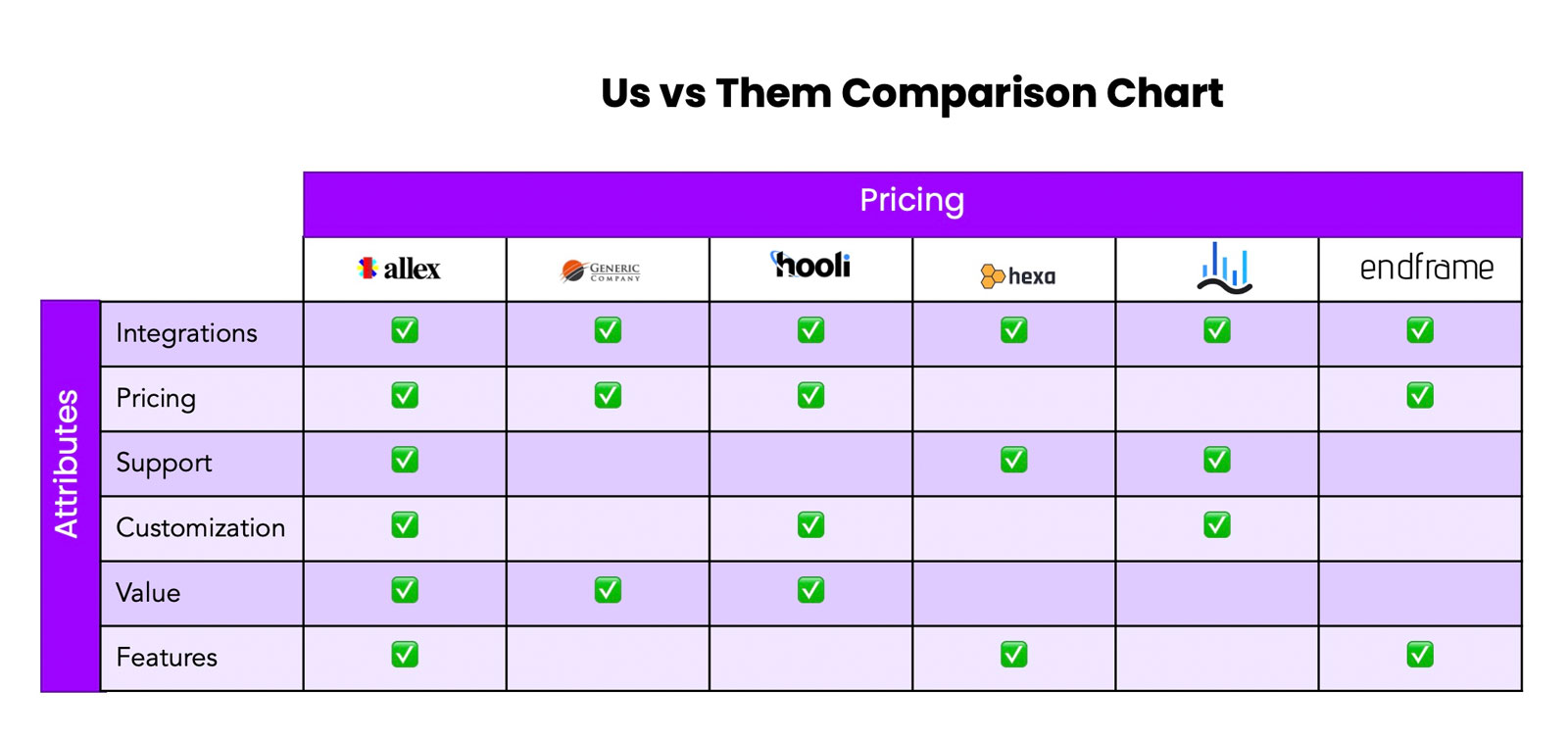
Caption: A comparison chart like this one is exactly right for an objection on a call and a level too shallow for the person running your security review.
The answer exists, timely access is the real issue
Picture an SE running evaluations for an observability platform. Mid-market accounts, usually against one of the two obvious rivals, usually a four to six week POC.
The deal that got away went like this. Success criteria were agreed in week one and looked fine on paper. Ingest volume, alerting latency, a handful of dashboards the platform team wanted rebuilt. In week three someone on the customer side asked about cardinality limits on custom metrics, because their service tags were about to multiply after a migration. The competitor's SE had already given them a number. The rep on the other side of the table had to go find out, came back with a caveated answer two days later, and by then the customer had built their own mental model of who understood the problem better.
The technical win went the other way. The deal followed.
Here is what makes that painful. Someone at the company already knew the answer. It had come up in a security questionnaire eight months earlier and the response was sitting in a spreadsheet in a shared drive. It had come up again in an RFP that spring. The information existed twice over, and neither copy was reachable by the person who needed it during a live POC.
That is the actual failure. Not missing intel. Intel that exists in a place nobody can get to in the two hours that matter.
Only three or four competitors ever reach a technical evaluation
The competitors that make it to a technical evaluation are a smaller and stranger group than the one on the company's landscape slide.
Some are the obvious head-to-head rivals. Their name shows up across your CRM, they turn up in most bake-offs, and they target the same buyer you do. Those are worth deep documentation.
Then there are the ones going after the same budget with a completely different product. A prospect who does not buy from you might not buy from your closest competitor either. They might extend a tool they already own, or hand the problem to two engineers and a set of scripts. Losing to a homegrown solution is common in technical deals and almost never appears in competitive content, which leaves SEs improvising the response every time.
And there is the uncomfortable third group. Companies you partner with in one account and compete with in another. Your reps will walk into that situation and stall, because the co-sell motion and the competitive motion point in opposite directions. A written position on how to handle those calls is worth more to an SE team than another feature grid.
Sorting competitors this way takes an afternoon. Presales can do it faster than anyone else in the company, because you were in the rooms where it happened.
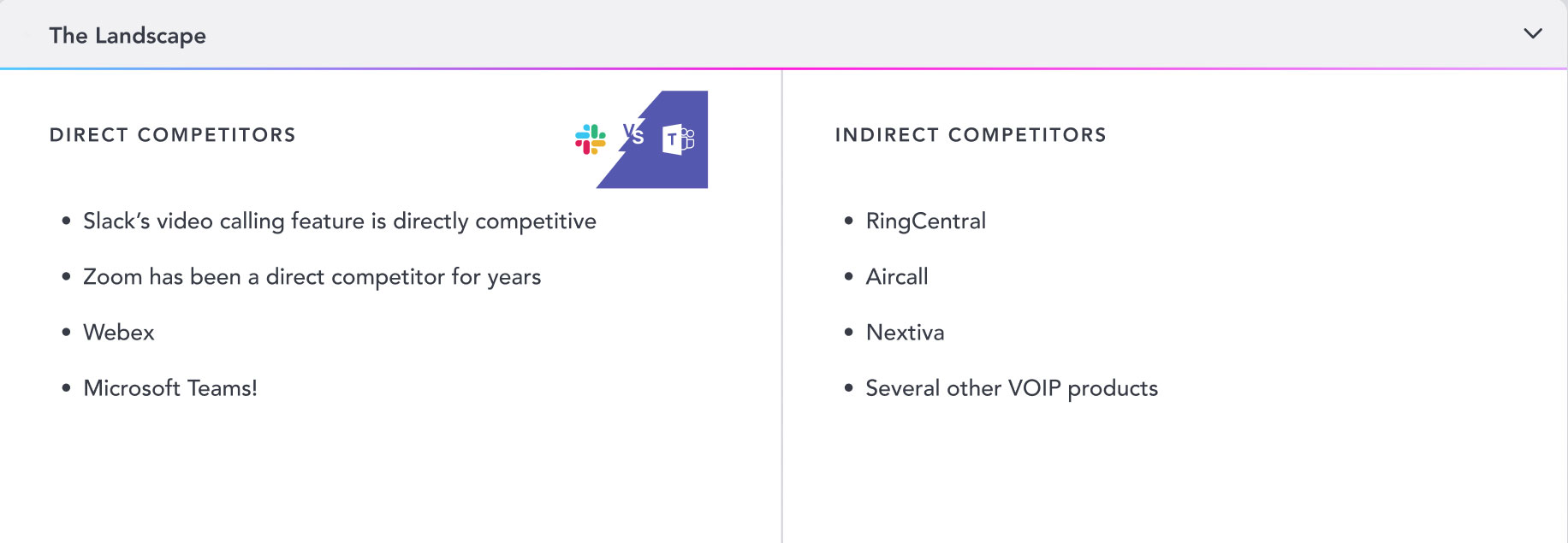
Caption: Direct competitors get the deep documentation. The indirect ones, including the tool a prospect already owns, decide more technical deals than most competitive content admits.
Capture competitive detail inside the work you already run
The advice to write things down is easy to give and easy to ignore, because it lands as extra work on top of a full deal load. The version that actually holds is the one attached to something you already do.
Add a competitive section to your POC debrief
Most teams run some kind of close-out after a proof of value, even if it is informal. Two extra questions belong in it. Which competitor was in the evaluation, and which single technical question moved the customer most. That second answer is the highest value competitive artifact your company can produce and it takes thirty seconds to capture while it is fresh.
Treat your technical win criteria as a competitive document
The criteria you negotiate at the start of a POC are a map of what the buyer cares about, and when you lose one, you know exactly which capability decided it. Tracking which criteria you fail against which competitor gives product a roadmap input that came from the field rather than from a survey.
Mine the answers you have already written
Security questionnaires, RFP responses, architecture review notes, and past POC plans contain most of the technical detail an SE needs, written by people who had to be accurate. The reason nobody uses them is retrieval. Getting that corpus into something that answers a plain language question, whether that is a well structured wiki or a layer that sits on top of your existing responses, turns eight months of buried work into something reachable mid-call.
Write down where you lose
If a competitor genuinely handles multi-region deployment better than you do, say so, then document the workaround and the deal profiles where it stops mattering. An SE who knows the one thing they cannot win on is far more credible in an architecture review than one holding a document where every column is green.
Date every claim
Include when it was checked and where it came from. The first time someone repeats a fact that stopped being true two releases ago, the whole document loses its authority.
The test for any of this is the same. Can a rep or a newer SE get a defensible technical answer in under a minute without interrupting a person? If not, the senior SEs are still functioning as the search interface, no matter how good the underlying content is.
Judge any tool on retrieval speed, not on its feature list
Plenty of teams get most of the way there with a well maintained wiki and a searchable channel. Once the volume of competitive questions gets past what search can handle, the category worth looking at is knowledge automation, meaning tools that connect to the content you already have and answer questions against it rather than asking you to rewrite everything into a new system.
Platforms like 1up connect to the places competitive and technical content already lives, including Drive, Confluence, past RFP responses, and completed security questionnaires, then answer plain language questions from Slack or a browser extension while a rep is still on the call. The same content also drives RFP and security questionnaire automation, which matters for presales because it is the same corpus either way. 1up has a free tier worth testing before anyone gets asked for budget.
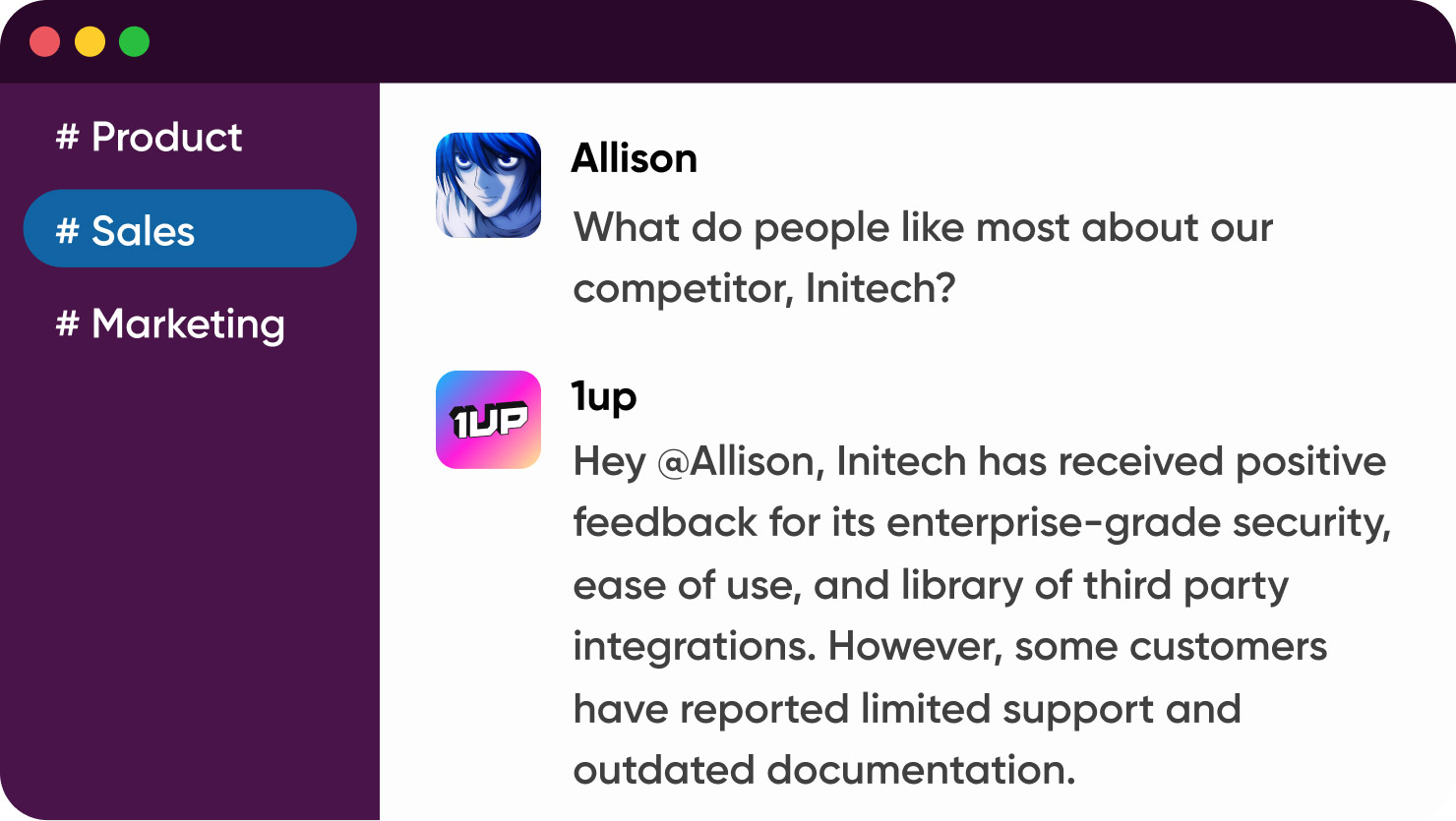
Caption: The question and the answer in the same place the rep is already working, while the call is still going.
Here’s a short walkthrough of the competitive use case:
Video: https://player.vimeo.com/video/1048648828?dnt=1&app_id=122963
Whatever you land on, judge it on retrieval. Load in one real security questionnaire and one competitive teardown, then ask it the hardest question you fielded last quarter. A tool worth keeping hands back an answer you would be comfortable saying out loud in an architecture review, and it does that fast enough to use while the call is still going. That is the bar, and the good ones clear it on day one.
The goal is fewer repeat questions, not less time in deals
None of it removes presales from competitive deals. You will still be in the room for the architecture review and the hard part of the POC, and that is the right place for you to be.
What it removes is the repetition. The same question, from a different rep, about the same competitor, at the same stage, for the fourth time this quarter. That question has an answer already. It is usually sitting in a questionnaire response from last spring, or in your head, and neither one is somewhere the next person can find it.
