


.webp)

RevOps planning happens in rooms presales is rarely in. Stage criteria get set, CRM fields get chosen, tools get bought, and the SE team finds out after the fact. Those decisions determine which deals get worked and what an SE has to prove before one can move forward. The RevOps guide behind them has six pillars, from the sales playbook to the tech stack, and presales sits inside most of them.
The work is already happening without the title. An SE writes one objection response and three reps reuse it, which is enablement. An SE says a deal will never clear security review, which is a pipeline call that should move a forecast. Neither gets written down anywhere the company can use. The answer stays in a Slack thread, the forecast call stays verbal, and RevOps builds the system without either one.
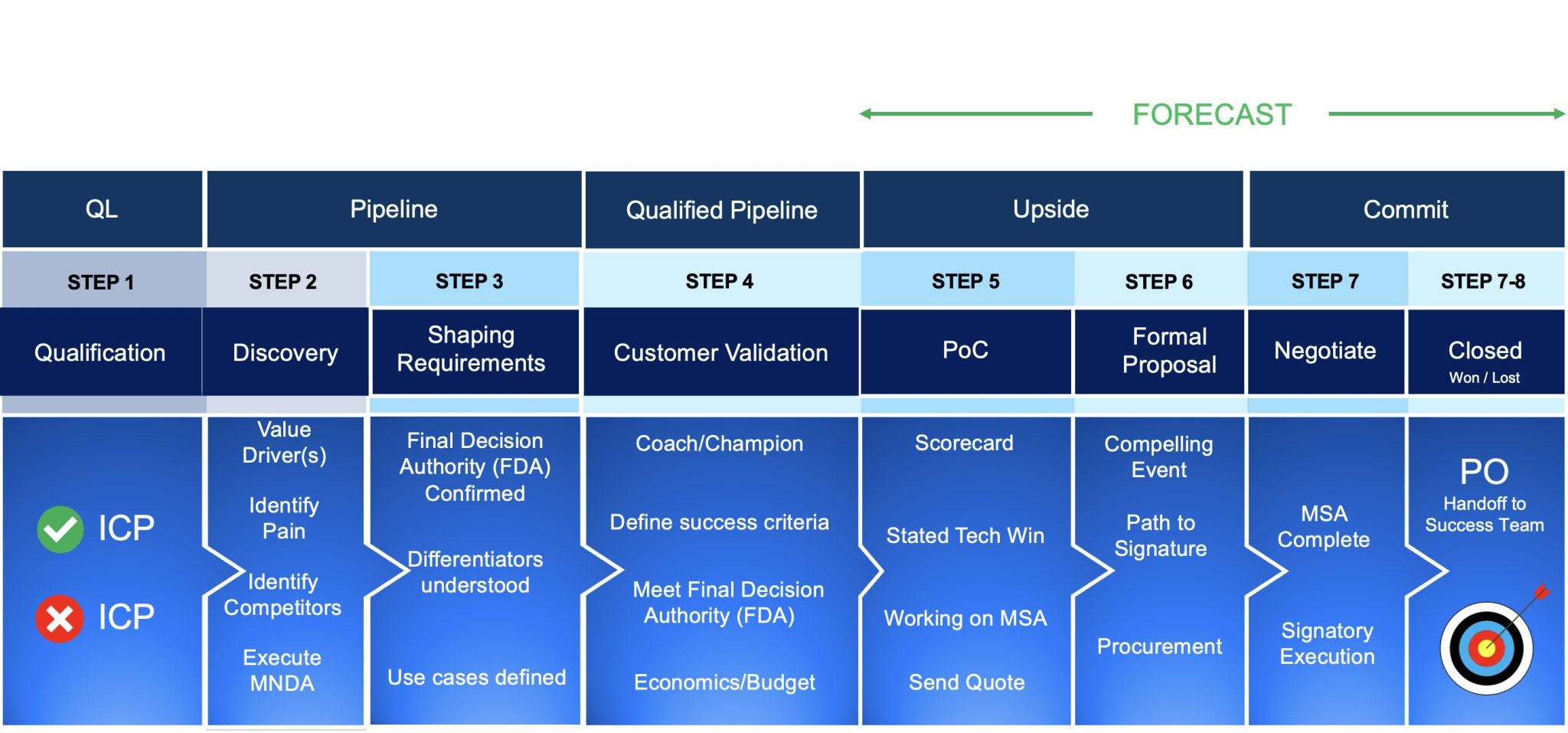
Pipeline Stages Break Down Without Someone Verifying the Technical Win
RevOps teams spend a lot of time defining pipeline stages with clear entry and exit criteria. Good stages tell you which deals are real. Bad ones give you a pipeline stuffed with opportunities nobody can rank.
The exit criteria almost always come from the commercial side. Has the buyer agreed in principle? Has procurement been looped in? Has a mutual action plan been signed? Those are fine questions, and none of them answer the one that matters most in a technical sale, which is whether the product can actually do what the buyer needs it to do.
That answer belongs to the SE. Nobody else in the deal has watched the integration fail in the sandbox or heard the security architect ask about data residency for the third time. When the numbers on RevOps maturity point to forecast accuracy as the main payoff of a tight process, the missing input is usually technical validation.
Push for a stage gate that requires an SE sign-off. It does not need to be heavy. A single checkbox that says the technical requirements have been confirmed as feasible, plus a short note on what is still open, will do more for forecast accuracy than another round of reminding reps to update their close dates.
The follow-on benefit is that you get a record of why deals stall technically. After two quarters you can point to patterns. Three deals lost on SSO gaps is a roadmap conversation. One deal lost on SSO is an anecdote.
The Sales Playbook Is Missing the Answers SEs Give Every Week
A sales playbook is supposed to hold everything a rep needs to sell: the process, the qualification method, the battlecards, the objection handling, the pricing logic. Most playbooks cover the commercial side well and go thin the moment a question gets technical.
That gap is where SEs lose their week. The same eight questions come in over and over. How does your permissions model work. Where does our data live. Can we deploy this in our VPC. What happens to our integrations when we hit the API limit. Each answer gets typed out fresh in Slack, read by one person, and lost.
Presales should own a section of the playbook. Not a tidy marketing version, but the real one, with the caveats included. A good technical section covers the answers reps can safely give without escalating, the questions that always need an SE, and the ones where the honest answer is that the product does not do that yet.
If your team is building this from scratch, a milestone-driven sales playbook template gives you the skeleton to fill in.
The test for whether the section is working is simple. Count how many Slack pings you get in a week asking something the playbook already covers. If the number does not drop, the content is either wrong or nobody can find it.
CRM Data Quality Breaks at the Exact Fields Presales Cares About
CRM hygiene is a running joke in sales for a reason. Reps update the fields that affect their commission and skip the rest. RevOps chases them. Nothing much changes.
Rather than fighting that whole battle, presales teams should pick a small number of fields and fight for those. The ones worth the effort are the technical ones nobody else is tracking:
- Technical loss reason, separate from the general closed-lost reason. "Lost on price" and "lost because we have no SOC 2" lead to very different fixes.
- POC or trial outcome, including whether it ran to completion and what broke.
- SE hours on the deal, even as a rough estimate. This is the only way to prove which deal sizes are worth an SE and which are burning the team.
- Security review status, since it is often the hidden gate that decides close dates.
Four fields is a reasonable ask. Forty is not. RevOps leaders are far more likely to say yes to a small, specific request that comes with a clear reason attached.
Once those fields exist, the data starts arguing on your behalf. A team that can show the average deal with SE involvement closes at a higher rate has a budget case. A team that can show which competitor keeps winning on architecture has a product case. This is also where AI is starting to take real work off the RevOps plate, since pulling patterns out of messy deal data used to be a manual slog.
Territory and ICP Planning Gets Sharper When Presales Feeds In Disqualification Signals
Territory planning and ideal customer profiles usually get built from firmographics. Company size, industry, revenue band, geography. All of it comes from data that describes a company from the outside.
Presales holds the inside view. SEs find out within twenty minutes of a technical discovery call whether an account is a fit, and they find it out for reasons that never show up in a firmographic filter. The prospect runs an on-prem stack that will not talk to your API. Their data team is three people and none of them have capacity. They have a homegrown tool the VP built himself and will defend to the end.
Those signals are gold for building an ideal customer profile that holds up. A firmographic ICP tells you who to call. A technical ICP tells you who will actually implement.
Start collecting anti-patterns. Write down the technical traits shared by accounts that stalled, churned, or never made it out of POC. After a dozen entries you will have a disqualification list that helps reps walk away earlier, which is the most underrated form of revenue work there is. For teams building the quantitative side alongside it, the GTM planner from Unusual Ventures is a solid free starting point for modeling coverage and capacity.
Bring this to territory planning conversations. If two regions look identical on paper but one is full of accounts running a stack you integrate with cleanly, that is not a small difference. That is the difference between an SE team that ships POCs and one that spends every quarter building workarounds.
A RevOps Stack Without a Knowledge Layer Turns SEs Into the API
Every RevOps stack has a CRM, a marketing engagement tool, some flavor of sales intelligence, and a customer engagement platform. The layer that usually gets skipped is knowledge automation, which is the one presales feels the absence of most.
Without it, the SE team becomes the lookup service. Reps ping an SE because that is faster than searching Confluence. The SE answers. The answer disappears into a DM. The next rep asks the same thing. Multiply that by a team of twenty reps and you have a full-time job nobody was hired to do.
A knowledge layer fixes the routing problem. The answer gets written once, stored where it can be found, and served back without a human in the loop. Tools in this category pull from your existing docs and let reps get answers to technical sales questions without an escalation. Guru and Elastic play here too, and the right pick depends on how much of your content already lives in a structured system.
The same layer does the heavy lifting on questionnaires. RFPs and security reviews are the most predictable time sink in presales, and they are also the most automatable, since the questions repeat across deals. Automating responses to RFPs and security questionnaires is now standard practice rather than an experiment:
VIDEO: https://player.vimeo.com/video/882460794?dnt=1&app_id=122963
One caution worth repeating. Buying the tool does not fix anything by itself. If the underlying content is stale, automation just serves stale answers faster. Someone on the presales side has to own content accuracy, and that ownership should be named rather than assumed.
Enablement Should Train Reps on the Product the Way Customers Break It
Enablement programs cover messaging, discovery, negotiation, and objection handling. They rarely cover the product at the depth a technical buyer will probe. That is how you end up with a rep confidently telling a prospect something the product has never done.
Presales should own the product knowledge track. Not the polished feature tour, but the version that includes the limits. What the integration does not cover. Where performance degrades. Which use cases need professional services. Reps who know the edges sell with more credibility, because technical buyers can tell immediately when someone is reciting a datasheet.
Objection handling deserves the same treatment. The commercial objections get rehearsed constantly while the technical ones get improvised. Build a shared library of the real ones with real answers, and consider tooling that helps reps handle objections without escalating every time. Newer hires benefit most, since AI-assisted enablement shortens the ramp that used to take two full quarters.
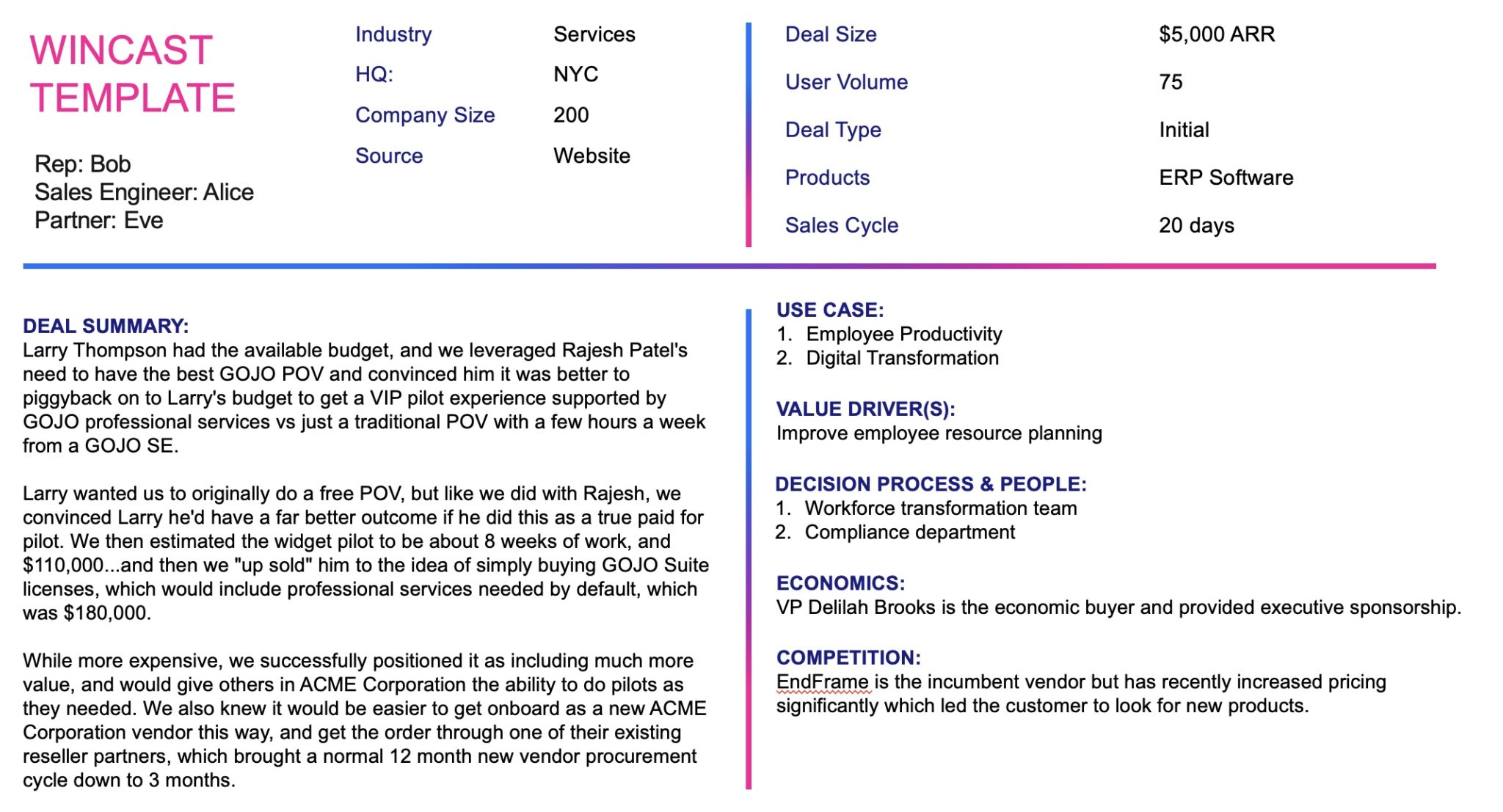
Win stories are the last piece and the one presales teams skip most often. When a deal is won on technical grounds, write down what happened. What the buyer tested, what nearly went wrong, and what closed it. A free WinCast template gives you a consistent format so these do not turn into rambling Slack posts.
Presales Does Not Need a RevOps Title to Do RevOps Work
None of this requires a reorg or a seat on the leadership team. It requires showing up to the conversations where the system gets designed and bringing the data nobody else has.
Pick one of the six. The CRM fields are usually the easiest to land and the fastest to pay off, since they cost RevOps almost nothing and give presales a permanent evidence trail. Stage criteria are the highest leverage if your forecast is a mess. The knowledge layer is the one that gives your team its calendar back.
The teams that get this right stop being the group that gets pulled into deals late and start being the group that shapes which deals get run at all.
