


.webp)

A few things I am still learning about where AI agents help, where they do not, and how Agentic AI impacts the nature of PreSales and Solutions Engineering Teams.
I recently spent an afternoon on an episode of the PreSales Podcast with Jack Cochran and Matthew James, working through a question none of us has fully answered. How do you make SE teams better with AI when there's no map?
This conversation took us down some interesting paths, two of which inspired this article. Now, agentic technology has unlocked a previously impossible set of new personalized experiences and workflows. These flows will impact PreSales account coverage, workflows and day to day. So I compiled Matthew, Jack and my conversation to help SE leaders navigate how tooling will impact their profession.
The conversation had two main legs and a cautionary tale.
First, the rise of autonomous demo agents will handle the moments no human was going to reach, paired with a consolidated platform that gives the SE coverage and influence across the whole sales cycle instead of just one slice of it.
Second, agentic workflows that connect what's already happening, like call recordings, into the things SEs actually do next: building the demo, coaching the rep, drafting the follow-up.
The recurring warning was AI slop… where tools produce output nobody checks and create more work, not less. And to counter this was the hope that new tools will allow SE’s a return to the core of the job: storytelling, trusted-advisor conversations, and owning the room.
AI is your new co-worker, here to stay, here to serve, hopefully this helps you navigate the new era.
Where SE Teams Should Start When it Comes to AI
Matt, Jack and I agree, if we were running an SE team right now, this is where we would start.
Map where your team's hours actually go before you buy anything.
AI pointed at a broken process just gives you that broken process at scale. Audit two weeks of calendars and find the back-office time sinks first: prep, documentation, competitive intel, and gathering context across tools. Buy or build against the sink, not the hype.
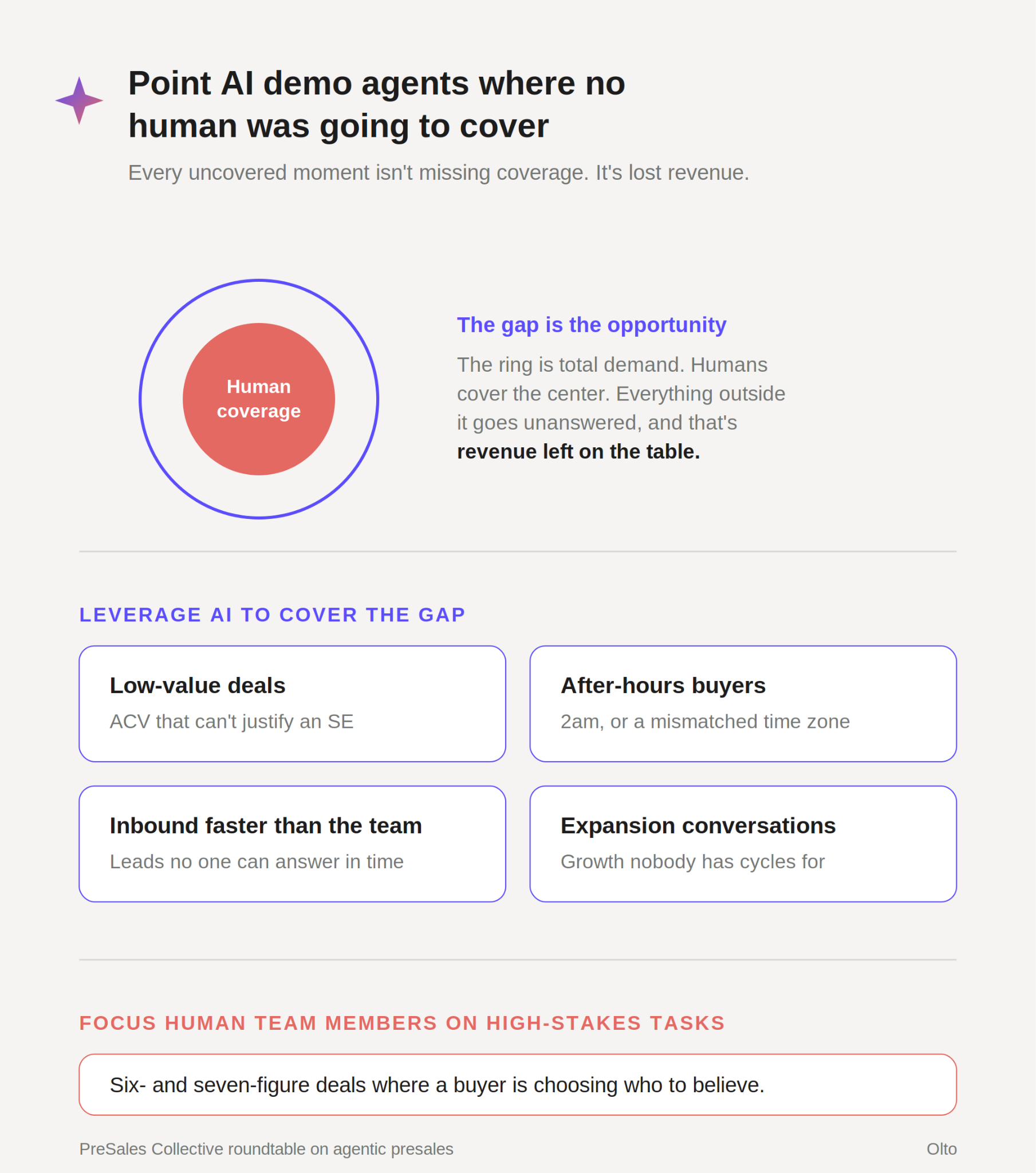
Point autonomous demo agents first at the moments no human was going to cover.
The deals below your coverage line. After-hours buyers and mismatched time zones. Inbound that arrives faster than the team can answer. Expansion conversations nobody has cycles for. An agent that qualifies a buyer, runs an early walkthrough on their schedule, and books the next step is doing work that was otherwise going undone. The alternative in those moments is not a human, it is nothing. Win those before you point agents at high-stakes, trust-forming conversations.
Set a standard for AI output and hold to it.
Anything AI generates should be edited with the same care as an email to your best prospect before it reaches a customer or an SE. Make it an explicit team norm rather than a hope. Unchecked output does not save time. It pushes the checking cost downstream and multiplies it.
Invest in soft skills now, deliberately.
Whiteboarding, storytelling, translating a business need into a technical one, and owning the room. These are the skills that hold their value when AI can script almost anything. Role-play coach bots are a practical way to practice them on demand, without the bias of a reviewer who always gives the same note.
Consolidate onto one platform
Or invest in an orchestration layer, so context and the SE's influence carry across the cycle. What I keep seeing work is a shared place where the whole team operates from the same understanding of the customer. The value is the shared context, not any specific tool. There is also a bigger prize than tidy tooling. When one platform powers first touch, demo, leave-behind, and onboarding, the SE stops being rationed to a single act and starts influencing the whole journey. Six disconnected tools each hold a fragment and reset the context at every handoff. One platform compounds it, and the person who understands the product best gets a say at every stage instead of only on demo day.
Treat personalization as a narrative problem, not a data problem.
Swapping logos and numbers is not personalization. The story has to be specific to the buyer and stay consistent across every touchpoint, and that consistency is close to impossible when each moment is owned by a different tool with no shared model.
Have the agent-to-agent conversation with your team now.
Not because it is settled, but because your hiring and development bets depend on where you land. Whatever the timeline turns out to be, develop people for the trusted-advisor role that survives it.
Stitch one input into many outputs with agentic workflows.
The highest-leverage build connects what is already happening to what the SE does next. A call recording should not just sit in your conversation-intelligence tool. It can feed the demo that gets built, the coaching the rep gets, and the follow-up that goes out. Start with one chain, call recording to demo configuration, prove it works, then extend it to coaching and follow-up. The goal is not a pile of agents. It is a connected workflow where context flows from one step to the next without anyone re-keying it.
Ultimately, by following these steps, and asking yourself these questions, you will be able to build alongside agents.
The debate worth continuing
The liveliest disagreement we had in our chat was about how far this goes.
The boldest case is that we are only a few months from buyers bringing their own AI agents to the call, and not long after that, agent-to-agent discovery and demos. I will admit I hope that one is wrong, because I love explaining technical solutions to humans.
The pushback is worth taking seriously. One view runs the other way. When products increasingly look alike, buying from someone you trust matters more, which makes humans more important in presales, not less. A middle position holds that there will always be a tailored proof-point demo run by a trusted advisor, even as simpler solutions get more automated. The framing I find most useful sits in between: reps become editors of what their agent shows and says. The endgame may be agent-to-agent, but the next few years are humans curating AI output.
I do not think anyone has resolved this, and that is the point. It is the debate to keep running with your team, because the answer changes how you hire and develop people starting now.
Three things I would leave you with
First, shift the mindset from scarcity to abundance.
The old SE function was rationed. There were never enough people, so they were saved for one moment, usually the demo, and the rest of the cycle ran without them. AI does not shrink the SE function. It widens what an SE can influence: top of funnel, mid-cycle, expansion, onboarding, renewal. Wherever the product needs a translator into the buyer's world, the SE has a seat now. I would frame the year that way to your team and your CRO, because the leaders who keep telling a scarcity story will lose their best SEs to the ones telling an abundance story.
Second, start small, with the work no one was doing.
The fastest way to build trust in AI inside a team is to point it at coverage gaps, not at the moments your senior people own. Autonomous demo agents fit the deals below your ACV threshold, the inbound that arrives too early to justify a human, and the buyer who never gets qualified in the first place. Let AI prove its worth where the alternative was nothing. That is where the easy yes is, and it is how you earn the right to extend AI into more sensitive moments later.
Third, invest in a single platform or an orchestration layer that connects the moments where a product specialist adds value.
The leverage is in the chain. A call recording that becomes a demo configuration, a coaching note, and a follow-up. A discovery call that becomes a leave-behind the champion can forward. You do not need a procurement cycle to start. Claude, Custom GPTs, or Gemini Gems are enough to stitch the first workflow together this quarter and see what compounds. Pick one chain, land it, then widen.
Consolidation is where we are seeing the industry heading. Building tech happens so much faster than it did even a year ago, so there is no excuse for SaaS to not have the full feature set, and no excuse for teams to be fragmented across disparate tools.
I am still working out where the lines are. The SEs in this community have taught me most of what I know, and the ones treating this as a chance to widen their influence are the ones I would bet on.
If you want to continue this conversation, feel free to reach out to me directly to discuss. I will make myself available to anyone in the PSC community.
About Olto
Olto is a single platform of product-trained AI agents for the moments that actually decide revenue. From one capture of your product, the platform builds autonomous demo agents that qualify and run early-funnel inbound on the buyer's schedule, live demos with data injection tailored to the deal in front of you, interactive product tours, how-to guides, and product videos. One product model, many shapes of buyer experience, so your SEs influence the full cycle instead of one act.
If you want to compare notes on agentic workflows, autonomous demos, or what's working in product-trained agents across the funnel, reach out at olto.com/demo.

About the Guest
Kintan is the CEO and co-founder of Olto, a single platform of product-trained agents for every demo experience, including tailored live demos with data injection, product videos, interactive tours, and onboarding guides. Olto's autonomous agents do discovery, qualify leads, navigate the product, and deliver live demos to customers, all built on learnings from years of developing voice agents at Alexa. Olto recently acquired Hexus AI to accelerate its vision for product videos and how-to guides.
Kintan spent over a dozen years at Amazon as a GM and product leader, where he helped start and scale Amazon Music, the Podcasting business, Prime Video's X-Ray, and IMDb. Since 2012, he has been building the music experience for Amazon's voice agents, Alexa. As an inventor, he holds 10 patents for voice agents and personalization. Earlier, he held product leadership roles at Microsoft and co-founded Securamed.
Kintan is also an active early-stage investor with 70+ portfolio companies, including Twilio, Turing, and Deductive, and serves as an independent board member at Ridecell.
